The Perfection That Cannot Be Kept
El Dorado is not a cruel satire of utopia — it is presented as genuinely good. Its people are content, its government just, its religion simple and without fanaticism. There are no Inquisitors. What distinguishes it from every other place Candide has visited is the complete absence of the violence, hierarchy, and cruelty that have defined his journey. Yet Candide cannot remain. The reason he gives is precisely what the novel has been questioning: desire.
"I own, my friend, once more that the castle where I was born is nothing in comparison with this; but, after all, Miss Cunegonde is not here, and you have, without doubt, some mistress in Europe. If we abide here we shall only be upon a footing with the rest, whereas, if we return to our old world, only with twelve sheep laden with the pebbles of El Dorado, we shall be richer than all the kings in Europe. We shall have no more Inquisitors to fear, and we may easily recover Miss Cunegonde."
The Desire to Distinguish Oneself
The most damning detail is not that Candide misses Cunegonde — it is that he wants to be richer than all the kings of Europe. El Dorado offers equality; Candide wants superiority. Voltaire identifies this as a structural feature of human psychology: the drive for distinction, for comparison, for status — the same drive that creates aristocracy, empire, and the slave trade. Paradise fails not because it is imperfect but because the human desire for relative advantage makes equality feel like deprivation.
Utopia as Diagnosis
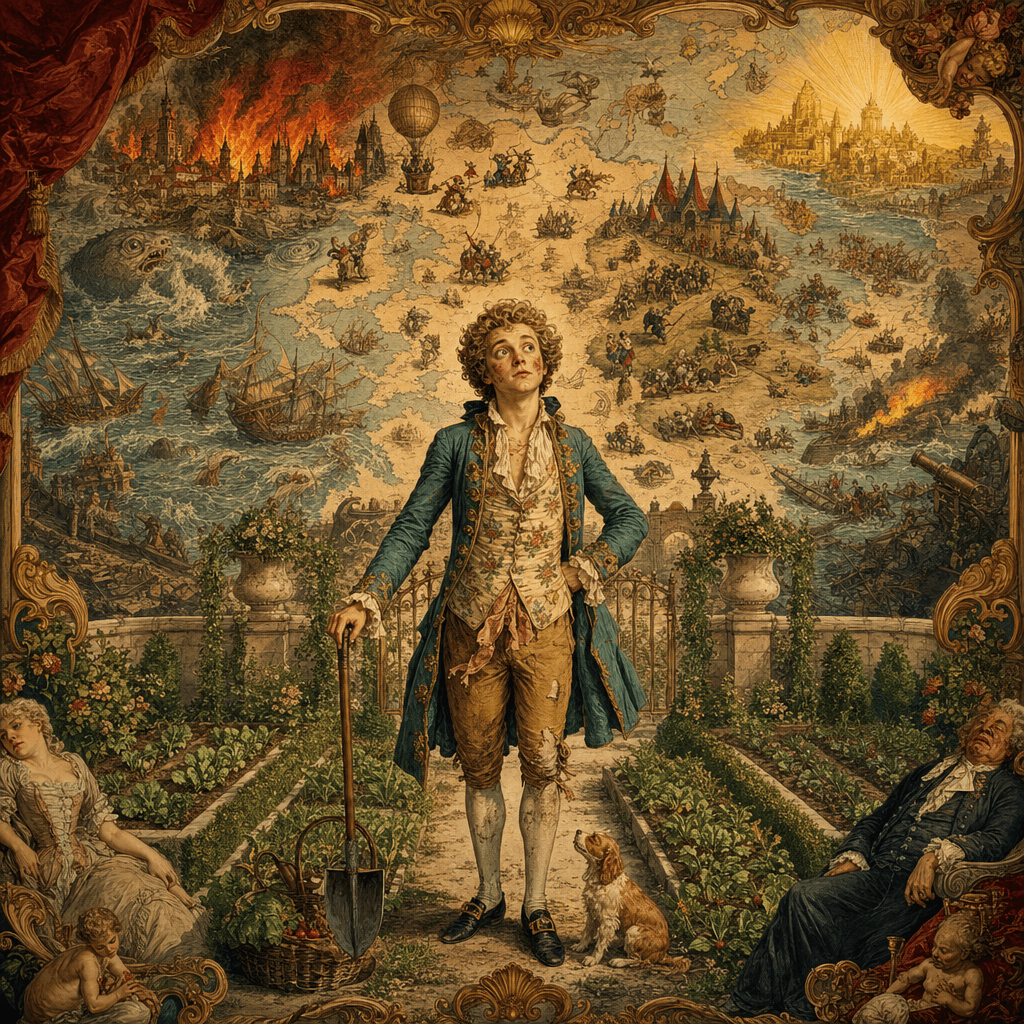
El Dorado serves Voltaire as a diagnostic tool rather than a prescription. By showing what a good society might look like — no priests disputing, no lawyers extracting fees, no kings claiming divine right — he sharpens the critique of existing Europe. The impossibility of El Dorado is not geographic but psychological. Candide carries Europe with him; he cannot leave his competitive, possessive, Panglossian self behind. The novel ends not with a return to El Dorado but with a small garden: a more modest, achievable, but genuinely human version of the good.
El Dorado appears in Chapters XVII–XVIII. The legend of El Dorado — a city of gold somewhere in South America — was a recurring European fantasy of wealth and abundance. Voltaire inverts it: El Dorado's gold is worthless there, and its real riches are political and spiritual.
Related Concepts