Two Versions
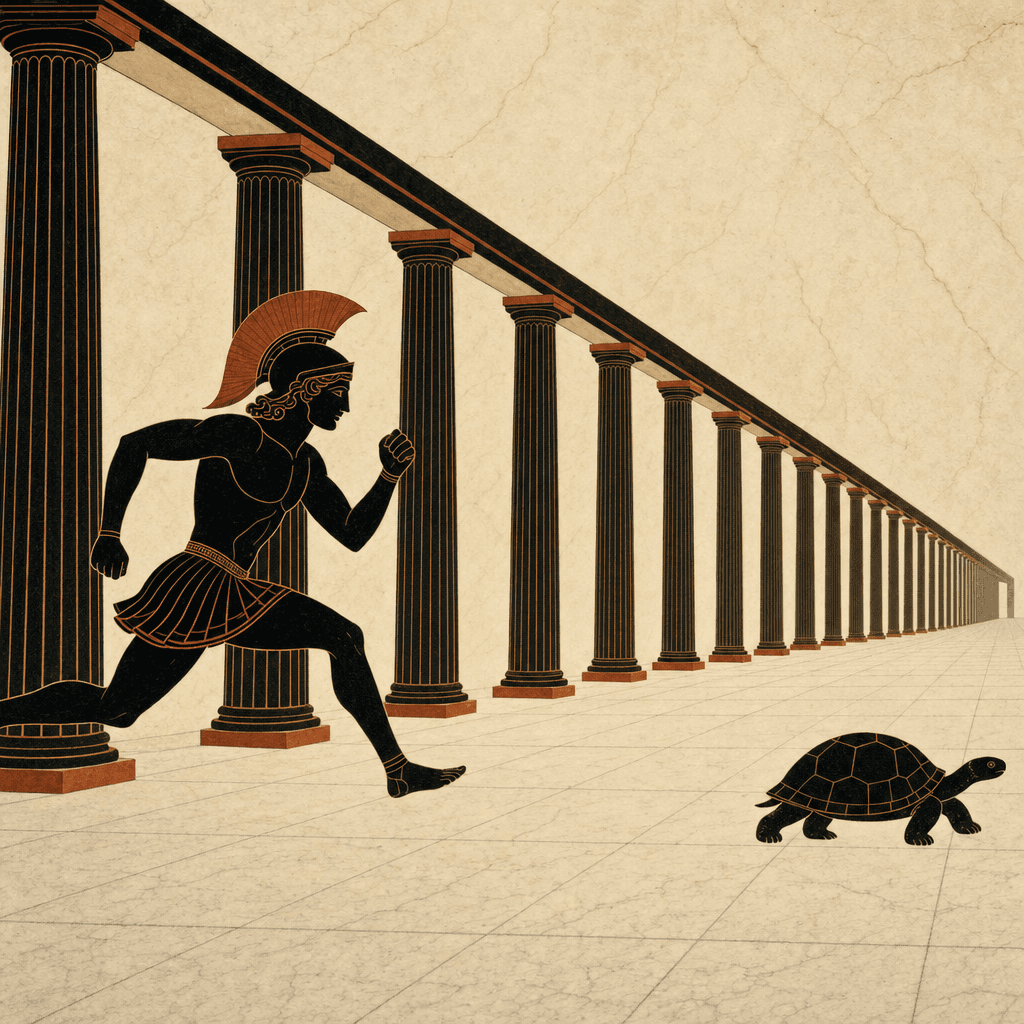
Aristotle reports two forms of the Dichotomy. The progressive version says you cannot complete a journey because you must reach the halfway point, then three-quarters of the way, then seven-eighths, and so on — generating infinitely many tasks to complete. The regressive version is more radical: you cannot even begin, because before any first step there is a yet-smaller step to be taken first, and so on without limit. Neither version shows that Achilles goes slowly; both show that the very concept of beginning or completing a motion is incoherent if space is infinitely divisible.
The Problem of the First Step
The regressive Dichotomy raises a question that the convergent-series response cannot fully dissolve: which is the first sub-interval in a journey? In any finite interval, every sub-interval has a sub-sub-interval before it. There is no smallest positive length. This means there is no first action the mover can take — no first portion of the journey that is genuinely the starting-point of the movement. The mathematical response gives us the total length and duration of the journey but is silent on how the journey gets started at all.
Relevance to Continuity
The Dichotomy is ultimately an argument about the nature of the continuum. If space and time are continuous — if they are not composed of discrete minimal units — then between any two positions or moments there are infinitely many others. This makes motion appear infinitely complex, and every finite journey appears to involve the completion of an infinite task. Mathematical physics handles this with the tools of the calculus, but philosophers continue to debate whether the continuum is ultimately real, whether space and time have a discrete atomic structure at the Planck scale, and whether the paradox reveals a genuine feature of physical reality or an artefact of our mathematical models.
The Dichotomy is described by Aristotle in Physics VI.9 (239b11–14) and by Simplicius. It is the logical twin of the Achilles and the most direct statement of Zeno's programme: if infinite divisibility is assumed, motion is impossible.
Related Concepts