Two Kinds of Thing
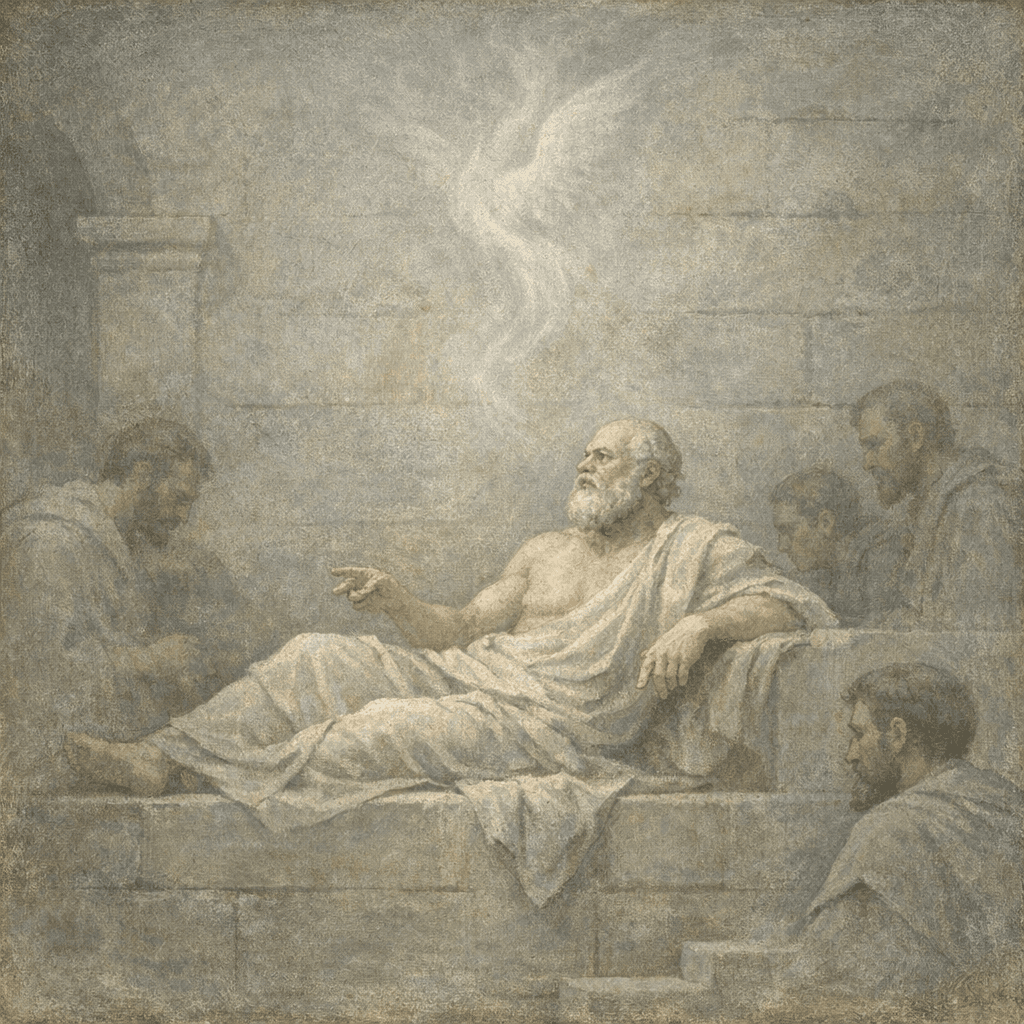
Plato draws a sharp distinction between two kinds of being. On one side: the unchanging, the invisible, the simple, the intelligible — the Forms and everything that belongs to the eternal realm. On the other side: the changing, the visible, the composite, the sensible — the things of the physical world. Every existing thing falls on one side or the other of this division, and its fate — dissolution or persistence — follows from which side it belongs to.
The body is clearly composite: it is made of many parts, it changes constantly, it grows old and decays. When something composite is dissolved, its components separate. The body, being composite, dissolves. What is simple and without parts, by contrast, has nothing to separate into — it cannot be dissolved, and so it cannot die.
But when returning into herself she reflects, then she passes into the other world, the region of purity, and eternity, and immortality, and unchangeableness, which are her kindred, and with them she ever lives, when she is by herself and is not let or hindered; then she ceases from her erring ways, and being in communion with the unchanging is unchanging.
The Soul as the Philosopher's Evidence
The soul, when it reflects, accesses the Forms directly — not through the body's senses but through its own rational activity. In this mode it resembles the Forms: it is engaged with what is unchanging, and in that engagement it partakes of unchangingness. The philosopher's practice is therefore itself a kind of evidence for the affinity argument: the more the philosopher withdraws from bodily engagement and pursues pure thought, the more clearly the soul shows its kinship with what is imperishable.
The Objections and Their Weight
Simmias and Cebes raise serious objections. Simmias suggests the soul might be like a musical harmony — real and non-physical, but still dependent on the instrument, and so destroyed when the instrument is destroyed. Cebes suggests the soul might outlast many bodies but still eventually wear out. Socrates addresses both in what follows, but the affinity argument establishes the framework: the soul's resemblance to the eternal is not incidental — it is, if the argument holds, what the soul fundamentally is.
The affinity argument appears in Chapter 2 of the Phaedo, after the recollection argument. It should be read alongside the two objections Simmias and Cebes raise (the harmony theory and the weaving analogy), which together force Socrates into the more rigorous final argument of Chapter 3. The affinity argument's influence persists in philosophical and theological accounts of the soul's natural orientation toward the divine.
Related Concepts