The Paradox of Recognition
The argument begins with a structural observation about knowledge. When we judge that two things are approximately equal, we are comparing them to a standard — equality itself — that is not present in either thing. The sticks are never perfectly equal; yet we know what perfect equality would be. We must therefore have had prior contact with the Form of Equality before we encountered any physical sticks. Since we do not remember acquiring this knowledge in our current lives — it seems available to us from birth — we must have had it before we were born.
knowledge is simply recollection, if true, also necessarily implies a previous time in which we have learned that which we now recollect. But this would be impossible unless our soul had been in some place before existing in the form of man; here then is another proof of the soul's immortality.
Education as Awakening
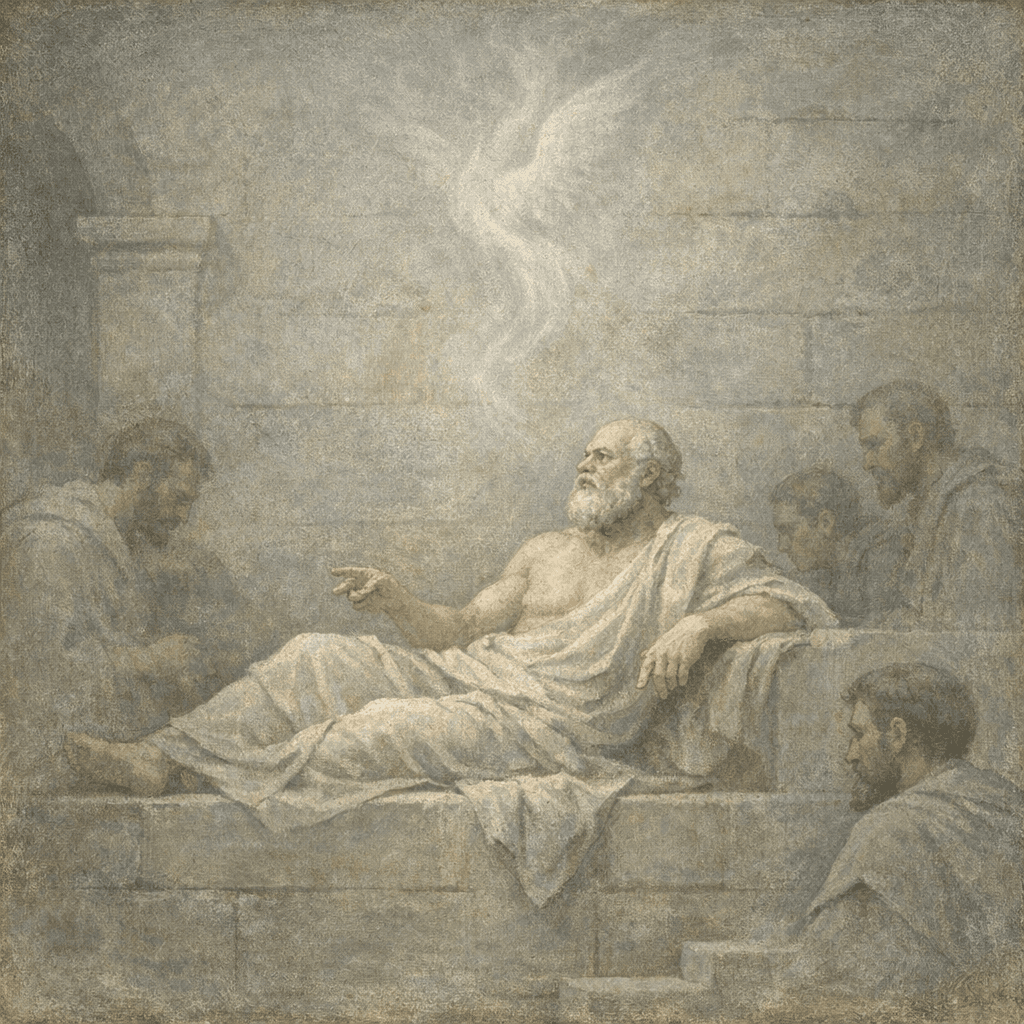
If knowledge is recollection, then education is not the transfer of information from teacher to student. It is a process of awakening what the student already possesses. The teacher does not put knowledge into the soul; the teacher helps the soul recover what it has forgotten. This explains Socrates's famous practice of questioning rather than lecturing: he does not tell people things, he asks them questions that force them to draw out what they already know. The method is not arbitrary — it follows from the metaphysics of learning.
What We Knew Before We Were Born
The objects of this prenatal knowledge are the Forms: absolute equality, absolute beauty, absolute goodness. We never encounter these in experience. We encounter approximately equal, approximately beautiful, approximately good things, and we judge them in relation to standards we already have. Those standards are the Forms, and we must have encountered them before we were born. This means not only that the soul is immortal after death but that it was active before birth — it was somewhere, seeing something, before it entered the body and forgot what it saw.
The argument from recollection appears in Chapter 2 of the Phaedo. Plato develops the same theory in the Meno, where Socrates demonstrates it by extracting a geometrical proof from an uneducated slave boy. The doctrine depends on a strong version of the theory of Forms: the soul must be able to perceive Forms independently of sense experience, which is why it must have existed before embodiment.
Related Concepts