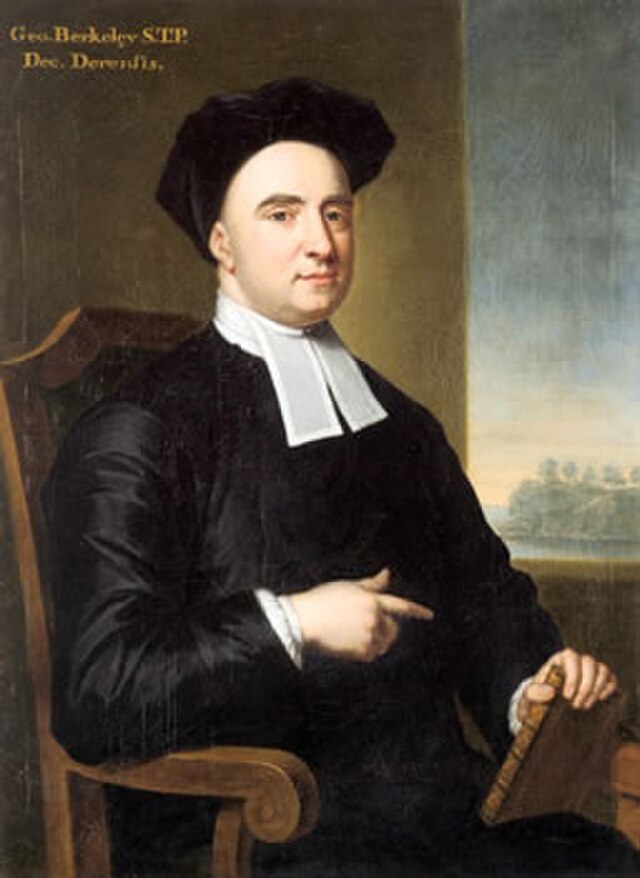
The Geometrical Point
The argument is disarmingly simple. A distance is a line directed endwise at the eye; its whole length collapses into one point on the back of the eye, the same point whether the object is near or far. Sight alone, therefore, cannot deliver distance.
It is, I think, agreed by all that DISTANCE, of itself and immediately, cannot be seen.
How We Come to Judge It
What we take for seeing distance is really a rapid, habitual inference. Faint or confused appearance, the turn and strain of the eyes, the sensations that accompany focusing — these are signs that experience has taught us to connect with far and near. We no more see distance than we hear a man’s thoughts; we perceive signs and supply the rest.
The Empiricist Program
The stakes are larger than optics. Berkeley is showing that a whole dimension of our experienced world is contributed by learning, not given in bare sensation — a case study for the empiricist thesis that the mind builds its world from the connexion of ideas. The New Theory of Vision is the laboratory in which the arguments of the Principles are first tested on a concrete problem.
The opening sections of An Essay Towards a New Theory of Vision (1709).
Related Concepts