No Common Object
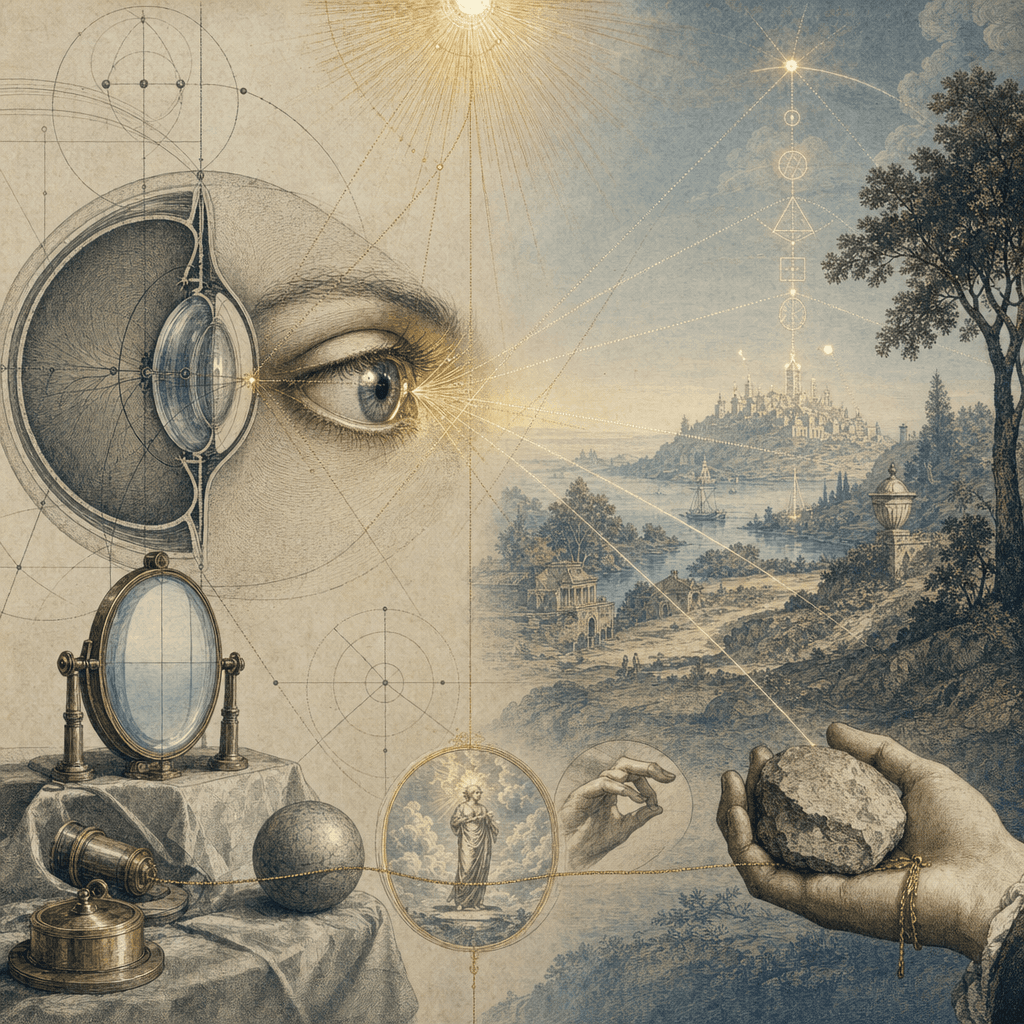
Visible extension and tangible extension, Berkeley argues, are not two views of one thing but two different kinds of thing. Nothing is common to them. We cannot even add a visible line to a tangible one to make a single continuous length, and quantities that cannot be added are, by the geometer’s own rule, heterogeneous.
The truth is, the things I see are so very different and heterogeneous from the things I feel that the perception of the one would never have suggested the other to my thoughts
The Man Born Blind
Berkeley’s thought-experiment — later famous as the Molyneux problem — imagines a man born blind who suddenly gains sight. On Berkeley’s view he could not, at first, know which visible shape belonged to the cube he had handled and which to the sphere, because his visual ideas would be wholly new, connected to nothing he had touched. The connexion must be learned; it is not read off the ideas themselves.
the perception of the one would never have suggested the other to my thoughts, or enabled me to pass the least judgment thereon, until I had experienced their connexion
One Word, Two Ideas
Why then do we call both the seen square and the felt square "square"? Only because they are habitually joined, as a word is joined to its meaning. The single name disguises a duality of ideas. This heterogeneity is the linchpin of Berkeley’s optics and the ground of his claim that vision is a language: signs and things signified belong to different orders, tied by custom alone.
The heterogeneity thesis and the case of the man born blind are argued in the later sections of the New Theory of Vision.
Related Concepts